


How to Choose Custom Wall Clocks for Reception Areas

Last Updated: November 17, 2026
Quick Summary
Choose custom wall clocks for reception areas by measuring sightlines and worst-case viewing distance first, then sizing the dial with the 1-inch-per-foot rule as a minimum. Center the clock 60 to 72 inches from the floor, pick high-contrast faces, and specify a silent sweep movement.
- Measure clear wall space and the distance from the farthest guest seat before picking a diameter.
- A 24-inch clock suits a compact front desk wall viewed from 10 to 12 feet.
- Keep the clock center between 60 and 72 inches from the floor for seated visitors.
- Leave empty wall margin at least one-quarter of the clock's diameter on every side.
- Specify a silent sweep movement so ticking does not carry into a quiet waiting area.
Table of Contents
- Why Reception Wall Clocks Need Different Rules Than Home Decor
- Step 1: Measure the Wall and Choose the Right Clock Size
- Step 2: Pick a Clock Style and Shape That Fits the Room
- Step 3: Design Custom Logo Wall Clocks Without Losing Readability
- Step 4: Choose Personalized Wall Clocks for Business Branding
- Step 5: Select Large Personalized Photo Wall Clocks for Feature Walls
- Step 6: Order Your Custom Clock Online With a Design Preview
- Request Your Reception Clock Preview From TheBigClockStore
- Frequently Asked Questions
Why Reception Wall Clocks Need Different Rules Than Home Decor
A reception clock has one job a living room clock never has: it has to work for strangers. Custom wall clocks for reception areas are read by people standing, sitting, signing in, and waiting, often from across a lobby. That changes everything about size, contrast, and placement.
At TheBigClockStore, we build made-to-order clocks, and the reception orders that come back happiest are the ones where the buyer thought about sightlines before style. Here is the framework we walk customers through.
Sightlines, Viewing Distance, and the Visitor's First Impression
A sightline is the straight path between a visitor's eye and the clock face. In a reception area, that path is rarely straight on. Guests look up from a seated position, sideways from a signing-in counter, or across a room while waiting.
Walk your lobby as a visitor would. Sit in the guest chair. Stand at the front desk. Check whether a column, plant, or monitor blocks the clock from any of those spots. If it does, move it, because a clock nobody can see is just wall decor.
Step 1: Measure the Wall and Choose the Right Clock Size
Most sizing advice stops at "bigger is better." In a reception area, size is a function of three measurements: how far the farthest guest sits, how tall the wall is, and how much clear wall you have. Get those numbers first, then pick a diameter.
- Measure the clear wall width and height with a tape, excluding door swings, light switches, thermostats, and any wall-mounted hand sanitizer or fire alarm.
- Measure the distance from the farthest guest seat, not the front desk, to the wall. That is your worst-case viewing distance.
- Measure the height from the floor to the center of where the clock will hang. A clock centered between 60 and 72 inches from the floor puts the dial at or slightly above eye level for a seated visitor and in view for someone standing at the counter.
- Pick a diameter using the 1-inch-per-foot rule as a floor, not a ceiling: a clock viewed from 15 feet should be at least 15 inches across, and most reception buyers go larger for presence.
- Tape a paper circle at the planned center point and view it from the guest chair, the signing-in counter, and the doorway before ordering.
Clock Diameter, Viewing Distance, and Wall Space
A 24-inch clock suits a compact front desk wall viewed from 10 to 12 feet. A 30-inch clock holds a mid-size lobby viewed from 15 to 18 feet.
Watch out: hanging the clock too high is the most common reception mistake. A clock centered above 78 inches reads as decoration from a seated position and forces guests to crane.
Our wall clock size guide breaks down how diameter relates to viewing distance and wall space if you want a closer match for your specific room.
Step 2: Pick a Clock Style and Shape That Fits the Room
Shape and finish are the easy part; the harder question is whether the clock will still look right after a year of lobby traffic. Reception clocks live in a harsher environment than home decor: direct sun through glass doors, daily wipe-downs, dust from entryways, and constant proximity to conversations and phone calls.
- Choose the shape against the room's dominant geometry. Round clocks soften rooms full of right angles and suit traditional, farmhouse, and hospitality interiors. Square clocks echo modern lobbies, conference room doors, and grid ceilings. Rectangular or panoramic faces work on long, low walls where a round clock would look stranded.
- Match the frame finish to the hardware already in the room, door pulls, signage, light fixtures, rather than to the paint color. A brushed nickel frame in a room full of brass reads as an accident; a brass frame in the same room reads as intentional.
- Pick the face color for contrast, not for palette. A black face with white or gold markers reads as executive and hides smudges. A white face with black numerals reads as clean and clinical and shows every fingerprint. In a high-touch lobby, a mid-tone face with high-contrast markers is the most forgiving.
- Specify a silent sweep mechanism. A ticking quartz movement is audible in a quiet waiting area, and in a small reception room the tick carries to the front desk and to anyone sitting within a few feet of the wall. A continuous-sweep movement removes the sound entirely and is the standard choice for consultation rooms, therapy offices, and any reception where people sit in silence.
- Confirm the face material can take cleaning. Glass and acrylic faces wipe clean with a standard non-ammonia cleaner; printed paper faces under glass are fine but should not be sprayed directly. Ask how the face is sealed before you buy if the clock will hang near an entryway where dust and road salt collect.
- Check glare before you commit. A glossy face hung opposite a window or under a direct downlight will throw a hot spot that washes out the hands at certain times of day. A matte or satin face, or a mounting position offset from the window axis, solves it.
Accessibility and Inclusive Legibility
A reception clock has to work for visitors with low vision, for people reading it from a wheelchair, and for anyone glancing up from a phone. Three things matter more than style: contrast between hands and face, contrast between numerals and face, and numeral size relative to the dial. High-contrast black-on-white or white-on-black dials outperform decorative low-contrast designs every time. Avoid thin or hairline hands that disappear at distance, and avoid Roman numerals on dials smaller than about 20 inches, where the thinner strokes blur. If your brand palette is low-contrast, put the brand color in the frame or the second hand and keep the dial itself high-contrast.
Materials and Construction for a Busy Lobby
Frame material drives both look and longevity. Metal frames hold up to cleaning and sun; wood frames warm a space but can fade near a south-facing window; composite and acrylic frames are the lightest and least expensive but show scratches.
Watch out: a clock hung in direct afternoon sun will fade a printed face and can warp a thin frame over time. If you cannot move the mounting spot, choose a UV-resistant print and a metal frame.
Match the frame and face to the room's palette. A black face with gold markers reads as executive. A white face with black numerals reads as clean and clinical.
Step 3: Design Custom Logo Wall Clocks Without Losing Readability
The mistake we see most often: buyers shrink their logo to fit the whole design, then wonder why nobody can read it from the door. A custom logo wall clock should treat the logo as the focal point, not a decoration.
- Keep the logo centered and generously sized
- Give it strong contrast against the face color
- Let numerals sit at the 12, 3, 6, and 9 positions rather than crowding the dial
- Test the design at arm's length, then at lobby distance
Our Modern Logo Wall Clock includes an instant preview so you can see your logo on the face before you commit.

Step 4: Choose Personalized Wall Clocks for Business Branding
Brand colors belong on the face, but only where they stay legible. Dark brand colors on a light face work well. Pale brand colors on white disappear. If your palette is tricky, use brand colors in the frame or markers and keep the dial high-contrast.
Personalized wall clocks for business do double duty: they tell time and they reinforce your identity with every visitor. Browse the full custom clocks collection to compare face styles side by side.
| Feature | Best For | Watch Out For |
|---|---|---|
| Logo at center | Brand-first lobbies | Logo too small to read |
| Numerals at 12, 3, 6, 9 | Clean, uncluttered dials | Missing minute markers |
| Full-color logo | Multi-color brands | Low contrast on white |
| Brand-color frame | Subtle branding | Clashing with wall color |
Step 5: Select Large Personalized Photo Wall Clocks for Feature Walls
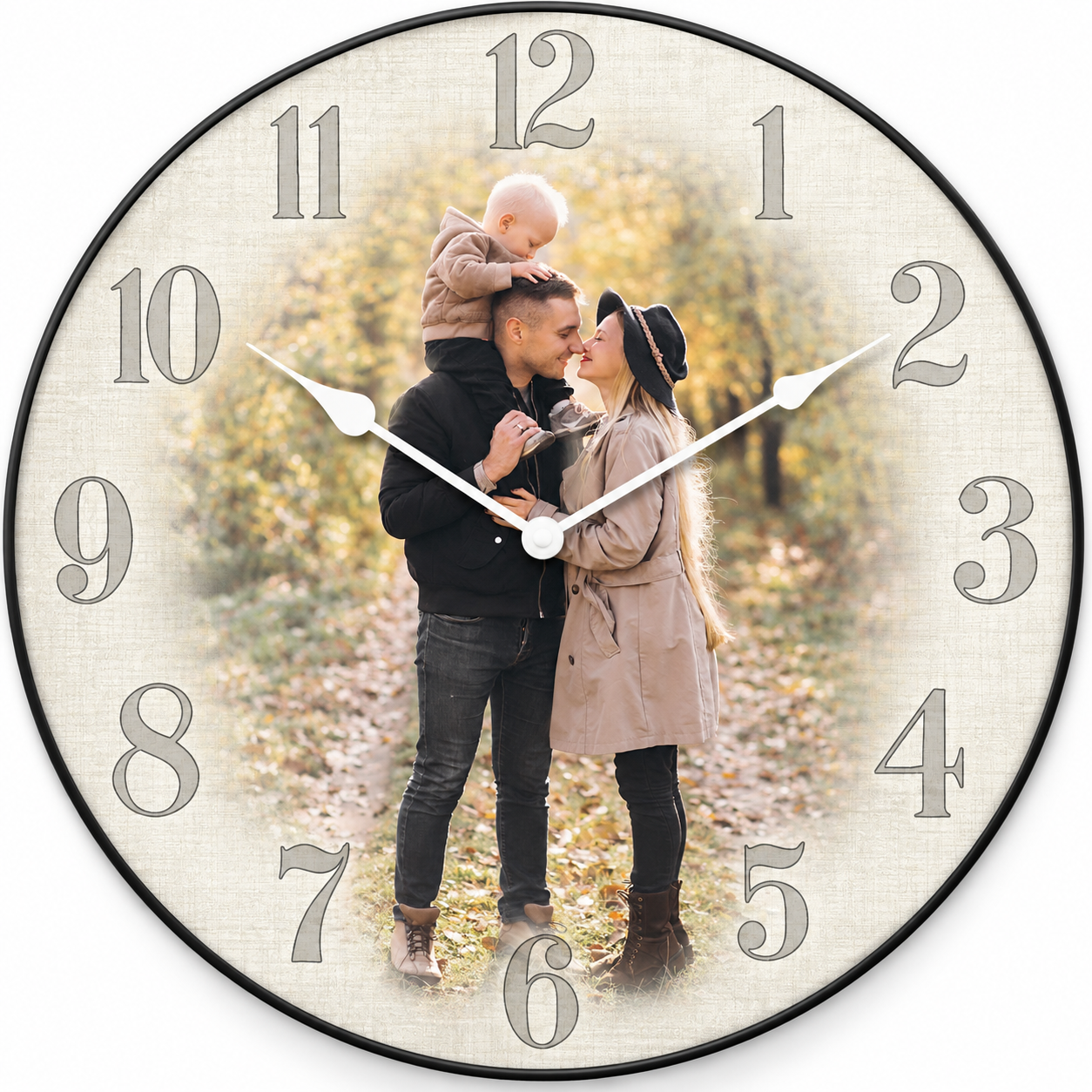
A feature wall needs a clock that earns the space. Large personalized photo wall clocks turn a favorite image, a storefront, a team photo, or a founding location into the centerpiece of the room.
Choose a high-resolution image and crop it so the important part sits in the center of the dial. Busy photos compete with the hands, so soften the background or pick a simpler shot. Our personalized photo wall clock comes in eight sizes with a quiet mechanism and a lifetime warranty, which matters in a space where people sit in silence.
Step 6: Order Your Custom Clock Online With a Design Preview
- Upload your logo or photo file at the highest resolution you have.
- Choose size, face color, and frame finish.
- Use the instant preview to check legibility at real scale.
- Confirm the design and place your order.
- Mount at a height where a seated guest can read it without craning.
A custom clock online order only works if you slow down at the preview step. Zoom in. Step back from your screen. If the numerals blur, the clock will blur on the wall.
Request Your Reception Clock Preview From TheBigClockStore
Getting a reception clock right comes down to seeing it before you buy it. We build every clock to order, with silent mechanisms, a lifetime warranty, and an instant preview so you know what will hang on your wall. Reach out through our contact page and we will help you size, style, and proof your reception clock.
Your lobby makes a first impression in seconds, and the clock on that wall is part of it. TheBigClockStore builds made-to-order clocks with silent mechanisms, instant design previews, and a lifetime warranty, all crafted in our workshop. Get started with TheBigClockStore and hang a clock your visitors can actually read.
Frequently Asked Questions
What size wall clock works best in a reception area?
Match the clock diameter to the viewing distance and wall space. A clock hung 8 to 10 feet from where visitors sit should read clearly at roughly 1 inch of diameter per foot of distance. Large custom wall clocks in 24, 30, and 36 inch sizes suit most reception feature walls and stay legible from the entrance. Measure the wall first, then pick the largest size that leaves comfortable breathing room around the frame.
How do I choose a clock face that is easy to read from across a room?
Prioritize contrast between the dial, numerals, and hands. Black numerals on a white face, or gold numerals on a textured black face, read faster than low-contrast color combinations. Keep the logo small enough that it does not crowd the number markers, and choose a dial style with clean lines rather than busy ornamentation. Test the design in a preview at the size it will be printed before you approve it.
Are silent wall clocks a good choice for reception areas?
Yes. A ticking clock carries across a quiet waiting room and can become the loudest thing visitors hear. Silent mechanisms remove that distraction, which matters in spaces where people are waiting, reading, or taking calls. TheBigClockStore builds silent mechanisms into its custom wall clocks, and the made-to-order pieces carry a lifetime warranty, so the quiet operation is a long-term feature rather than a short-lived one.
What should I include on a custom logo wall clock for my business?
Include your logo, your business name, and your brand colors, then stop there. Numerals at the 12, 3, 6, and 9 positions keep the time readable while leaving the center open for branding. Full-color reproduction lets brand colors come through as designed. Avoid placing text over the hands' path or crowding the minute track. A design preview lets you confirm the logo reads well before production begins.


